The Sixty-Second Letter: On Princesses and Dinosaurs

img_1570

Dear Daughters,

While breastfeeding the eldest, I read a lot of books. Given that she took forever to eat, and I didn’t have an older child constantly jabbering at me, it was not long before I coopted your dad’s Kindle and learned to love the one-handed ebook. I also got a lot of hardback books from the library, because they were heavy enough to lay open on my lap unassisted. It was all about logistics for me.

One of those library books was called Cinderella Ate My Daughter, a journalist’s well-researched discussion about early childhood gender formation in America, and the way, in particular, young girls learn the narrative of what it means to be a woman from media, marketing, and culture. Despite the title, it’s not just about princess culture (or American Girl culture or modesty or Disney movies, though all of that is in there), but about the messaging and potential concerns about the differences in the ways boys are marketed to (as explorers, geniuses, adventurers, tough guys) and girls are marketed to (cute, sassy, pretty, glam, even bratty).

It’s not that most of this was new to me, as I’d researched early childhood gender socialization as an independent study while a sociology major during undergrad. Gender socialization and how we learn to be well-rounded human beings in our communities is a topic that is important to me and has been for some time. It’s one I’ve spent a lot of time reading about and thinking about. I rarely talk about it, though, because it’s something other moms don’t particularly want to talk about.

So that’s a little bit of background.

Recently a friend gave us some hand-me-down princess dresses—and plastic heels, and a necklace, and fancy gloves.

You two love to wear these dresses.

I took a picture of you on that first day we opened the bag of hand-me-downs and sent some of my friends an accompanying text: “And so it begins…”

It’s been pretty cute that you don’t really know how to “play princess” because you don’t have context for it. (To the extent you know the names of the princesses, it’s from books and your friends at preschool.) So for now, “playing princess” is very similar to “playing family,” which means you basically assign roles to everyone and then set up the area where you are playing into a house. And then you move on to playing other things while wearing your princess dresses and clunking around in the plastic heels.

You call the shoes “tap shoes.”

A few months ago, a woman stood beside me in a very long line at a consignment sale as we watched a little boy being silly. Very silly. Goofball silly. Rambunctious and active. This woman turns to me, sees that I’m holding girls’ clothing, and sighs, saying that girls are so much easier at “this” age, but once they are teenagers, well, she’s heard that reverses itself.

While I was pregnant the first time, so before I knew if I was having a boy or a girl, more than one of my boy-mom friends said they preferred the crazy and chaos and rambunctiousness of boys who are “all boy” to the “drama, drama, drama” of teenage girls.

I hear “he’s ‘all boy’” all the time, by the way. And there is a general understanding about what “all boy” means—rambunctious, loud, active.

And I hear all the time that boys are so much easier than girls in the long run.

One of my best friends—who is a mother of boys and a girl–has said in a joking voice that one thing about raising boys that is preferable to raising girls is that with a boy, you only have to worry about one penis; with a girl, you have to worry about all the other penises.

I mean, it’s funny, right?

On the surface level, it is. I get that. It’s funny.

But all of these conversations about what boys are like and what girls are like make me uncomfortable as a mother of daughters but also as a woman and as a human being created in the image of God.

This cultural myth of the dramatic teenage girl who is such a handful and can’t be controlled and doesn’t get along with her mother?

I just don’t get why that’s the dominant narrative we continue to tell ourselves and expect in our families.

It’s like the terrible twos.

We expect it, we label it, and as it turns out, we embrace it. We are resigned to it.

I’m not saying middle school and high school aren’t rough. They’re tough years. They’re hormonal years. They’re the years children learn to be adults by figuring things out for themselves.

But I’m not dreading those years with you, girls. I’m not.

I think it’s foolish to assume we can’t get through it with grace. Yes, of course it will be hard in ways I can’t even imagine now, but I will not assume you will be unmanageable. I will not assume you will be disrespectful. I will not assume that the drama, drama, drama will come.

That’s not fair to you.

The thing is, I wasn’t a dramatic teenager. And I have plenty of friends who never got sassy and bratty and dramatic. I don’t ever remember slamming my bedroom door or wishing my parents would just die. That’s a trope.

And you know what? Even at your preschool, I know boys who are not rowdy and chaotic but serious and gentle.

I don’t mind that you wear the princess dresses around the house. (Though we do have a rule that they can’t be worn outside the house—none of this princess dress to the grocery store nonsense.)

Your dad pointed out that the littlest reminds him of Monica from FRIENDS in the episode where she cleans her apartment in the wedding dress. It cracks us up.

I don’t need to go on a rant about princess culture generally and the Disney princess movies in particular. I’m sure by the time you’re reading these letters, you’ll know where I stand on those things. I think they are troubling, but lots of things are troubling. It doesn’t mean you can’t wear the dresses. As long as princesses are just one thing you play among other wonderful and imaginative things, I’m okay with that.

I will say in brief that the main problem with the whole princess thing to me is the way it becomes the dominant narrative through which some little girls can see the world.

But you are not those little girls.

You walk around in Cinderella’s dress with yellow plastic heels, and you’re still growling with your hands up as claws, saying you’re a big, scary bear.

You wear your dresses while you’re putting together a puzzle of the Amazon rainforest, or while you’re building a tent with the old king-sized sheet hanging off your bunk-beds, or while you’re coloring with markers in a coloring book that is not princess-themed.

Yesterday, the littlest put a canvas bag over her shoulder and said she’s a mommy dinosaur going to the grocery store. Because of course mommy dinosaurs need to go to Kroger.

We have a small princess figurine who gets carried around with Daniel Tiger and Katerina and Miss Elaina. It’s pretty great because the princess is usually a stand-in for Teacher Harriet. I’m good with that.

Yes, as long as princesses are just one narrative among others, just one story among others, just one game among others, I’m good with that.

So, go ahead and wear those dresses.

Wear those tap shoes.

Heck, strap on fairy wings.

I don’t care what you sport as we read Rosie Revere, Engineer, and Ada Twist, Scientist, again and again and again. Those your favorite books at the moment.

I’m good with that.

Love,

Your Momma
The Sixty-First Letter: Why Not All of It?

img_5264

Dear Daughters,

I’m a stickler about a few things.

One of them is tithing.

It is not a cool thing to talk about, especially not in my circles, but I was raised to take tithing seriously, and so I do take it seriously. When I was little, I’m pretty sure I was made to tithe off of my allowance and even off of the money we got in birthday cards. Yes, growing up, there was a strong sense of this money not being mine to begin with and so we gave back to God a portion, a tenth, in order to remind ourselves that it really all belongs to God, that none of it really belongs to us.

In today’s world, I think most of us could use a little more of those reminders that what we have is not really ours. That it is all gift. That we deserve none of it.

It might help us stay away from the what’s-mine-is-mine mentality that not only keeps us from helping our neighbors but also makes it difficult for us to see them as equally deserving of our own way of life.

It’s not polite to talk about money though, so I don’t say these things out loud, don’t say them in public.

But let me tell you a story.

The eldest has been joining us for “big church” for some time now, and I was reading an article recently about the importance of children seeing their parents–literally seeing us–give of our time and our resources. The article specifically mentioned letting children see their parents put money in the plate at church, if the family attends a church that passes the plate. It talked about the potential correlation between children who witness their parents giving of time and talents and tithes on a regular basis and those who grow up to be regular givers themselves.

After reading this article, I realized that it probably didn’t send the best message that I was often passing an empty plate. As I said, I do tithe, but I write a check once a month, because it’s our habit, instead of once a week. So the majority of weeks, we don’t drop something in.

As a result, I decided, if it’s a symbolic gesture for you anyway, I’ll start giving you a little bit of cash to put in the plate yourself. In the past, this always seemed a little silly to me.

And that brings me to the story for today.

On Sunday, I had grabbed some cash from my wallet that was all folded up on itself. I pulled two dollar bills off of the wad–there was only ten dollars in the wad, but it looked big to you–and I handed you the two single bills. You saw that I was putting the rest back in my wallet.

“But why not all of it?” you whispered to me.

I tried to shush you.

“WHY NOT ALL OF IT,” you whispered louder, assuming I hadn’t heard you the first time.

I tried to shush you again, and gestured toward the plate as it approached.

You really didn’t want to let it go. “But why? Why not all of it?”

And it was about that time that I heard those words in a new light, not as a literal question about that wad of cash, but a question to me about life and what it means to offer ourselves to the Kingdom of God.

Why not all of it?

Why are we not willing to give all of ourselves?

Why are we so quick to pull the two easy dollars off the wad and toss them in the plate and assume we’re good to go, that we’ve done our part?

God isn’t asking us to do our part. God is asking us to give our lives.

Why not all of it?

When we get mad about politics, we think it’s enough to start calling our representatives. But God wants all of us, not just our phone calls and emails.

When we get frustrated at broken institutions like our school systems, we think it’s enough to just protect our own interests and make sure we (and ours) succeed. But God wants all of us, not just our feeble attempts at safety and provision for our own families and neighborhoods.

When we look around at our empty sanctuaries, we think it’s enough to lament the absence of young people and resolve to make our services more relevant. But God wants all of us, not just our work to make Sunday morning more fun. God wants us to to be loving people, offering our whole selves to our relationships, inviting people into our lives, not just our sanctuaries.

When we look around and see that all of our friends look just like us and live in houses just like us, we think it’s enough to go serve in a soup kitchen or donate our leftover and used goods to a local shelter. But God wants all of us, which might hurt a bit. Actually, it will hurt a bit. I promise. It might mean selling that house. At the very least, it means inviting people who are different from us into that house and joining together over food and fellowship. It will take all of us.

Or, let’s take it to the real, everyday annoyances of life. Because that’s where we can really get uncomfortable. It’s too easy to shrug off the general, big problems.

What about when I get frustrated at the frequency with which the neighbors’ dog has been escaping their yard? I want to think it’s enough to put him back in the yard and grumble about it to your dad. But God wants all of me, all of my relationships, all of my time, not just my mediocre attempts at community.

What about when I lose my temper with you? I think it’s enough to say, well, that’s the way life is with young children, right? It’s tiring and exhausting and mind-numbing, and you really should have just listened the first time. But God wants all of me, not just my good days and prayer times and Bible reading. We should be growing in those tough moments too. We should be learning grace and offering grace.

What about when the stranger walks by our house in the middle of the day, when the kids with heavy backpacks get off the bus down the street and look discouraged, when the neighbors have forgotten yet again that it is trash day: am I just doing the minimum? Or am I offering my whole life?

Why not all of it? you asked.

And I guess what I’m trying to say is this: you’re asking a good question.

The Gospel requires all of us. 

Love,

Your Momma

The Sixtieth Letter: Handwriting Is My Jam

img_3871

Dear Daughters,

I have, as long as I can remember, loved to write longhand on paper.

I have also, as long as I can remember, practiced my handwriting.

I don’t know what that makes me, but certainly some level of nerd. I remember in my teens when I started shifting my lowercase ‘a’ intentionally to look more like a typeset ‘a’ because I had noticed it in someone else’s handwriting and thought it was cool.

This means I have always been aware of letters and how they look on the page.

And I guess this means that I have been a typography nerd before I even knew what the word “typography” was.

Fonts matter a lot to me. And by that I mean they matter a lot more than they should. To me, fonts have personalities and they send underlying messages. So when an email or a sign or a book or magazine uses a font that sends a different message than the words themselves, I feel the same tension as when there are actual typographical errors on the page.

Yes, I’m that kind of nerd.

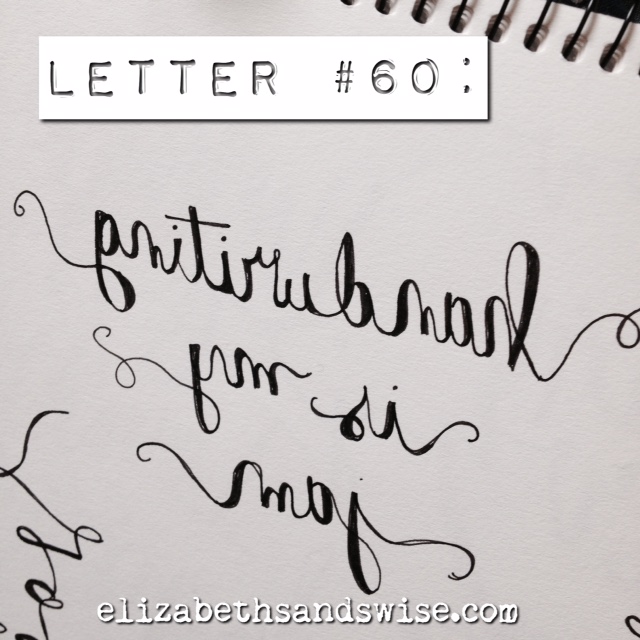
I remember practicing to write with my left hand in elementary school on the off chance I would break my right arm. I suppose I’m still able to do that, to write with my left hand, but I haven’t tried in a long time. I did try this evening to write backwards in cursive, as I used to in middle school. I remember exchanging notes with my friend Jess Kisner in backwards script back in eighth grade, holding the pages up to the light to read them easily as the backwards script reversed when read through the page. Why did we do this? Surely we knew anyone who obtained the secret note would be able to do the same thing. But at least, I suppose, nobody could read over our shoulders as we wrote those notes to each other.

When I was in high school, I began experimenting with what I would now call hand-lettering. I remember taking quotes and trying to make each letter of each word an artistic image or creative design. I remember, especially, writing out “every man’s death diminishes me” during one of our state government school programs at the capitol building. Clearly I was paying attention to the program. Clearly I’ve always been left-leaning in my convictions.

As I was an academically minded nerd, I didn’t take many art classes, even though they were offered by my large public high school. We actually had a great art program. But I spent my days enrolled in AP classes to get the weighted GPA, even then with the goal of valedictorian, which is only mysteriously important to me now as I look back on it.

As an adult in my twenties, I discovered an Austin-based graphic designer & typographer. I was looking around at his website and I had an epiphany. If I had known that people did this sort of thing for a living–that people studied and developed fonts and letter-based designs–the whole trajectory of my life may have been different. Isn’t that strange? I remember emailing your Uncle Stephen a link to the guy’s website and saying, “DID YOU KNOW PEOPLE DID THIS AS A JOB?

Seriously, if I had it all to do again, I would have taken more art, and I probably would have learned some graphic design along the way.

Because letters are so my jam.

I’m fortunate that as a mom of wee ones in my thirties, I have managed to carve out an art life. The “fortunate” part is that I’m part of a community that loves art, and I have artsy friends who are also squeezing art into their lives, who are organized enough to get together for weekly meetings to work through The Artists Way or Walking in the World, workbooks on creativity and calling and vocation and art.

I have a writing group made up of writers who also make art. These women commission me to paint for them. They are my biggest cheerleaders. Well, apart from your dad, who is by far the best encourager there is. He tells me I’m awesome all the time, and he believes it. Your Grandma Troutman also tells me I’m pretty great, pretty much every time I post a new letter. And your Uncle Stephen jokes about being the president of my fan club. So I’m definitely fortunate to have people who cheer me on when it comes to art.

But seriously, let me get back to this handwriting thing.

I love handwriting. I love to write. I love to copy down quotes. I love to hand-letter them into artsy designs just because. I like to make lists, as I’ve mentioned once or twice in these letters. I love to send real letters, with stamps and everything. I don’t know what it would be like to just sign my name to a generic card because I am kind of compulsive about writing out long messages to people. It’s like I just hiccup and suddenly there is a paragraph on the page.

I do love my handwriting. I’m such a nerd. I like to practice writing. I like to read about lettering. I like to read about fonts. I like to practice fonts.

And I love that you are learning to write your letters. I’m so excited to teach you cursive. I love how you sit beside me and watch me letter in my notebooks. “That’s so pretty, Momma,” you say, over and over and over again, as I write and doodle or paint my letters and sayings and verses.

“That’s so beautiful, Momma.”

“Good job, Momma.”

“You’re a good artist, Momma.”

You’re the sweetest little encouragers.

I have been impressed already with the way you seem to have an eye for design and image and beauty and style. Not because you like my art, but because you care about how things are. You take note of beauty in nature, and you notice when things are different. You comment on colors and designs. You love catalogs because of the repeated patterns, and you especially get a kick out of the fashion designs in my Vogue.

Sometimes I think I might be imagining it, but your dad has noticed, too.

It gives me hope that you, too, love design and art and beauty.

It gives me hope that you like letters and colors and layout.

It gives me hope that you might be a nerd just like me.

Love,

Your Momma

The Fifty-Ninth Letter: Am I Sheltering You?

img_3962

Dear Daughters,

Sometimes I worry that I am sheltering you too much.

Okay, actually, I worry about this a lot.

You really got bothered by the Ghost of Christmas Future in the Mickey Mouse version of A Christmas Carol this last Advent. The Mickey Mouse version. Your dad and I did not see that coming. But, of course, it’s about dying as well as greed, hostility, selfishness, and callousness, and you take those things to heart.

Because you are sensitive souls. Especially the eldest.

Sometimes I worry that you are sensitive because I am protecting you from Bad Things. Because you don’t know how the world “is.”

I look around at my community and it looks pretty homogeneous, and so even though we make an effort to buy books for you with diverse protagonists, and we even ask others to buy them for you, I still think sometimes, Am I sheltering you too much?

Yesterday, after we marched with our small town to remind others and ourselves that we stand for equality and that there is still work to be done, I talked to you about Martin Luther King, Jr.

I started out by talking out about how we are all children of God, created in the image of God. This you understood. This you embraced. Because this you know.

But then I told you that there are some people who don’t believe this, and that before I was born, there was a man named Martin Luther King Jr. who helped us to see how unfair it was to treat people differently because they looked different from us. He was a preacher and people listened to him. But not everyone was happy with what he was saying. People said bad things and did bad things.

As your eyes welled up with tears, I knew I was treading on dangerous ground. You cannot wrap your brain around someone being mistreated because she looks different than you do. You get sad when you see sadness. You cry when I cry, even if you don’t know why. I know this about you, and I saw it in your eyes, but it was important to me that you knew the truth of this story.

Still, I didn’t know how much truth to tell. When you asked if Dr. King was still alive, I told you he was not. You wanted to know what happened, and so I told you.

This was too much truth, and I could see it in your expression as you processed, in the change in your breathing. You got nervous.

I switched gears and talked about Old Testament prophets instead. And we talked about people in the Bible who died because others got upset when they preached truth, when they preached the message that God needed us to hear.

I kept circling around to the message that we are all children of God, how important it is to remember that we are all created in God’s image. This seemed like the thing to focus on. It’s also on my mind because of a Desmond Tutu book I’m reading.

But your little brain was still working, and despite your insistence that you were okay, those blue eyes were filled with tears.

That’s when I realized it. It is scary to you that people have died because they believe we are all children of God. It is scary because you believe we are all children of God. Because your dad and I believe we are all children of God.

I checked again to see if you were okay because you have this habit of trying to be brave. You say things like, “I’m fine, but my eyes are just watering,” when you are not fooling anyone. Your heart is so sensitive.

You asked to be excused from the table, and you went into your room to play.

A few minutes later, you began to sob. Loudly. You came out of your room, sobbing. Sobbing. Sobbing.

I sat down on the big gray chair in the living room to hold you, to offer comfort, knowing what it is like myself to be overwhelmed with emotion at the pain of the world. I asked you if you were afraid, and you told me, No.

“Just sad,” you said.

Just sad.

This morning, awake at 4 am with insomnia, I began to think again about whether you are too sheltered from the bad of the world.

The thing is, on a lighter note, it’s hard for me to get too worked up that you find Disney bad guys scary because you haven’t yet been made numb to the archvillain cartoon type. The fact that you haven’t been exposed to the bad guys means you also haven’t been overly exposed to the “good” guys, the princes saving the princesses, or the princesses themselves, which are to some degree just as dangerous, given the concerns they introduce regarding self-image, cultural biases, and understandings of what happily-ever-after love looks like. So I don’t care that you find caricatured scary dudes scary. The fact that you’re sheltered in your media exposure is fine with me.

But what about real life?

Well, I know that your dad and I have gotten a lot of things wrong in the last four years of “real life” parenting. I know that our faith calls us to love more, be more vulnerable, live less selfishly, speak truth more openly–and to teach you to do the same. We often fail at this. Over and over and over again, we fail. We are aware of these failings most days, and I hope we continue to challenge ourselves to live more faithfully to our callings.

But when it comes to sheltering you, to worrying about whether you’re exposed to enough “bad” things, well, I think I need to let this worry go.

For example, not many two- and four-year-olds have attended, in the last six months, their town’s first gay pride festival and picnic, witnessed their mother heading to the polls–twice, actually, given that the first time I went our precinct had run out of paper ballots–attended a Kentuckians for the Commonwealth fundraiser where we heard about state environmental and political concerns, and marched in an MLK day parade sponsored by our NAACP.

That’s real life, girls.

When you ask questions about people watering their lawns, we talk about water supply issues in Africa. (I’m not above a little indoctrination.) We talk with you about the great work your grandpa is doing with ex-convicts in Pennsylvania, and how he studies the Bible alongside inmates and visits those who don’t have friends or family members to visit them. When you talk about Christmas presents and Santa, we talk about the least fortunate. We make you sort your belongings and give things away on St. Nicholas Day. When we collect items for a Christmas Share-the-Joy family in our community, we talk about how there are very real people living in our neighborhoods who don’t have enough food to have a Christmas dinner, who don’t have fun things like brightly colored toothbrushes and yummy watermelon fluoride-free toothpaste. You walked with your preschool class to the food bank on Main Street and took a tour.

And the truth is, it’s not all words. You have been exposed to people who are different from us, but I work really hard, even when my heart isn’t in it, to not let you know that they are different from us.

We have friends and acquaintances with a variety of incomes, but we treat them all the same. We have shared our table with folks on fixed incomes and government assistance, who otherwise eat in soup kitchens, and we share our table with college professors. We try to treat them all the same. You have shared your goldfish and your sandbox with neighborhood children who don’t have milk in their homes to eat with their breakfast cereal, and you’ve shared your sandbox with children of dual-income earning parents. I try to teach you to treat them all the same.

When there are shady characters passing us on the street, and I have that stirring of fear so enculturated into me, that distrust of the stranger, it is important to me that you see me greet them with a friendly “Hello.” I refuse to teach you stranger danger, because I do not think that is the gospel message. (Many of my mom friends disagree with me on this. But we disagree on a lot of things. Like princess movies.)

All of that to say, when I read the Gospels, especially the words of Jesus, I know that we have miles to go before we are loving our neighbors as ourselves. I know that there is work to be done inside these four walls, and there is work to be done in our neighborhood, and there is work to be done in our city, our state, and our country. There is a lot of work to be done. I could be loving better, offering more hospitality, making more deliberate strides toward repairing the divisions I see in this world. We have not yet done enough.

Still, I do not think you are sensitive because you are sheltered, because you haven’t been exposed to enough bad things, because your world is curated and protective and safe. No, quite honestly, I think you are sensitive because I am sensitive. A lot of it is genetic.

But to the extent that it isn’t genetic, I want to affirm your sensitivities, your quickness to feel the pain of others, and not unwittingly numb it out of you by overexposure. I want to affirm your sensitive soul because it shows me you are on the road to compassion, journeying toward a heart breaking over the suffering of this world, toward an awareness that this world is not the way God intended it to be, toward a vocation to love.

And that is right where you should be.

Love,

Your Momma

The Fifty-Sixth Letter: Enough Space in the Manger

img_8524-2

Dear Daughters,

Your dad offered the children’s “moment” today at church.

(Yes, we are still old-school enough that we have a children’s sermon, but at least we try to sound a little less old-school about it by calling it a “moment.”)

Your dad is amazing, and I love how excited the eldest was to go up front with your daddy up there. You always love these weeks.

Your dad had all the children lean way back, as far as you could, and look up at the sanctuary ceiling. Then he had you rock back and forth, back and forth, back and forth, while he SHHHH‘d into the microphone.

SHHH. SHHH. SHHH.

Then he asked you what it felt like.

You see, the ceiling of our church is solid wood. I don’t know anything about wood building materials, but the visible ceiling is completely wood, with wooden boards one direction, all lined up, and then these big wooden beams, like a rib cage, across it.

Because of the shape of the sanctuary, it’s actually, incredibly, quite reminiscent of the inside of a boat.

SHHH. SHHH. SHHH.

Like the wind during a storm.

The church is a boat.

You kids got there really quickly. I was impressed. The church is a boat.

The capital-C Church is a boat, too. Or it should be.

The Church is a safe place in a storm, when Jesus is present; it is large enough to hold all of us, all who crawl on board.

That’s pretty cool.

And then your dad said something else, looking up at the ceiling again. Those wooden beams, the wooden structure, was a lot like a manger, too.

That SHHH. SHHH. SHHH. might be Mary’s voice, calming a baby.

And just think: we’re in the manger with Jesus.

It’s like the baby Jesus, this God-man, who was lying down on straw in this wooden framed manger, jumped up and flipped the manger on its head, to protect us, to keep us safe.

And there is space enough for all of us. Radical, upside-down, safe space, for all of us.

Enough space for the believer and the doubter, the cynic and the faithful, the college professor and the jobless, the worn-out mamas and the aging grandmamas, the teenagers who are less than pleased to be present and the elderly man taking a nap in the back pew.

And for those folks we are hesitant to include? Those who make us uncomfortable when we read about Jesus’ call to love our neighbors? Those people who are different than we are?

There is enough space.

In the manger.

In the boat.

That’s the message of Advent.

That is the message of the manger.

That is the message of our faith.

And that was the message of Faith Baptist Church this morning, during a children’s moment, with the kids lying on your backs, rocking back and forth, back and forth.

SHHHH.

SHHH.

SHH.

Love,

Your Momma

The Fifty-Fourth Letter: These Are Not the Best Moments

img_8029

Dear Daughters,

While on the road last week, enroute to Thanksgiving in Pennsylvania, we stopped at a Panera for dinner in West Virginia. (The two of you are always more happy with a bowl of macaroni and cheese than just about any other quick food options.)

As we waited for our little buzzer to light up and signal that our food was ready, I noticed an elderly couple looking at us from a nearby booth. I’m used to people looking at us when we are out as a family because, well, your dad and I are really tall.

Let me just say as a sidenote that I don’t feel abnormally tall most of the time, but given the number of strangers who comment on it, and the number of people who stare without commenting, and the number of strangers who obviously look down at my feet to see if I am wearing heels, well, I must look pretty tall out there in public, especially when I am with your dad, who is six inches taller than I am. And after bold strangers ask how old the two of you are, they are typically in disbelief at your height as well. Sigh. We’re a tall bunch.

My point is, when these strangers were studying us in Panera, I didn’t pay much attention to it. But then, after our food came, in the chaos of trying to make sure everyone had what they needed and dishing out the bowls of mac and cheese onto the plates so it would cool faster and tearing the top off the squeezey yogurt so you could eat them, the older man spoke to us, and he started off by saying something very strange.

“I really don’t like you,” he said.

Now, that is not normally how one strikes up a conversation with strangers, but I could sense that he was someone who needed to talk, and though his words were awkward, I had this hunch that maybe he was trying to be friendly, not abrasive, so I acknowledged him and encouraged him to continue.

“I seriously don’t like you. You know why?”

I didn’t, but I was sure he was going to tell us.

“I’m old.”

And by that, he meant that we were not old.

He proceeded to remind us, in a rambly sort of way, to enjoy these days when we are young and have young kids because he used to be young too and one day he woke up and he was old. He missed being young. He missed having his family around. He knew we couldn’t imagine it, but trust him, we needed to enjoy being young. We will be old before we know it. And, by the way, Happy Thanksgiving.

His wife came back, we wished him Happy Thanksgiving, and then they left.

My first internal reaction was sadness: I was sad that this man was sad, that even despite his attempt at humor, he was emanating regret.

But then, well, my sadness turned into less-than-compassionate annoyance. Here’s the deal, girls: as a mom of young children, I hear this message all the time.

All. The. Time.

And while I know it sounds ornery, I just need to get something off my chest.

One of my pet peeves is being told by strangers to “enjoy these days,” to appreciate the time I have with my children while they are small, to count my blessings because time goes by so quickly, before I know it my kids will be grown and out of the house. So enjoy it. Appreciate it. Cherish it. Blah blah blah.

Now, I’m not saying there aren’t young folks who need to hear this message, who would find it encouraging. But I kind of resent the assumption that I am not already doing this, that I am not already able to live in the moments and appreciate the beauty that is here.

Granted, I will be the first to admit that there have been times when I have not wanted to appreciate the beauty of these days–there have been times when I have wanted to flee (on the worst days) and longed for the minutes to pass more quickly (on the best days).

But right now, in this season, I am doing a good job living alongside you, enjoying the stunning and creative human beings you are, even as you exasperate me and I lose my temper more times than I like to admit. And so, when I am told to appreciate these days, I kind of resent the idea that any stranger feels like she needs to pass on this wisdom of a life well-lived, when implicitly this person is admitting that she did not do a good job of appreciating life when she was young. That really does sound ornery. I guess this is one of my buttons.

I work hard to live a life of gratitude and grace. It’s a daily struggle. And I often fail. But I’m on the path, girls. I’m on the path.

I see the hunt for the sacramental in these ordinary moments as one of my primary callings right now, not just as an example for you of a well-lived life but as an encouragement to others who need to see that hope is possible in the drudgery of the ordinary.

The other thing I resent when someone tells me in a chipper voice (or a somber voice, because, let’s face it, it can go both ways) to appreciate these moments because I will someday wake up and I will be old and have all these regrets–well, what I resent is the suggestion that these moments, here when you are young, are the best moments, the moments I will most miss later. These are not the best moments. And the future moments are not the best moments. All of the moments are the best. All of the moments are moments we are called to live fully, to love fully, to be aware of grace and live sacramentally. All of the moments. All of the seasons. Sometimes it is harder than at other times, and I’ve often suspected, even after talking to older moms, that in the extreme exhaustion of raising small children we have to work the hardest to find grace, but it is still here.

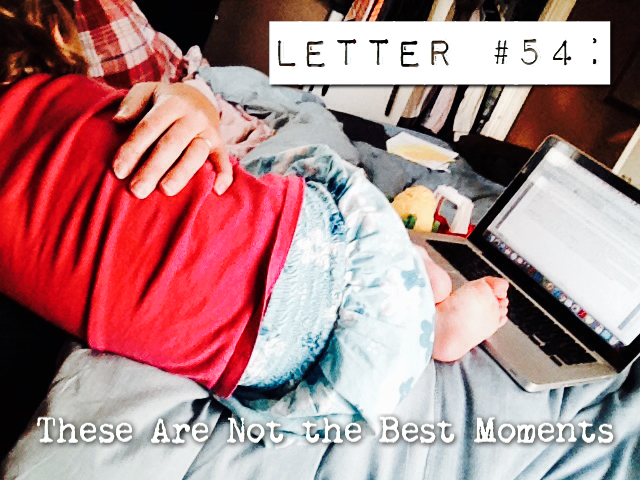
What I want to say to you, girls, today is this: I am living in this moment, right now, alongside you, and I am loving you and appreciating this life we share. I am feeling the late-afternoon sunshine dance across my laptop keys as I type this, and I see how beautiful it is. I am listening to an episode of Daniel Tiger in the background, hearing a deep belly laugh from the eldest, watching the youngest drink her milk with crazy bedhead. I’m sitting beside an empty mug of tea. Our white Christmas lights are glowing on our bare tree. I’ve still got my boots on because we are heading to some friends’ house for dinner, but I took my big earrings off to try to motivate myself to go outside and rake some leaves.

These are the silly details of a life that make me smile.

These are the details of the life we share.

These are the details of a life of gratitude.

I will not wake up surprised to be old one day.

I will not wake up surprised that you are old enough to read these letters one day.

Sure, the time is going quickly, quicker than I can even believe sometimes, but the moments, well, they’re the same every day. They’re full of promise. They’re full of grace.

Love,

Your Momma

The Fifty-First Letter: Love vs. Fear

img_7608

Dear Daughters,

Three or four months ago, I had a conversation with friends who are a few decades older than I am. Politics came up, because it always does. I made the comment that, although I realized the political situation seemed dire with so much at stake, I was pretty confident that in the scheme of things, the turmoil of this moment too would pass. And, I continued, no matter the outcome, it wouldn’t end up being as dire as it seemed right then.

My friends disagreed.

This was dire, they said. We are in desperate times, they said. So much is at stake, they said.

They made it sound end-of-the-world apocalyptic-ish, and these are not apocalyptic-predicting folks. (Trust me, because I know some of those kind of folks, too.)

Well, girls, let me be candid. When I read Scripture, that’s not the message I read.

Recently, your children’s Bible poignantly paraphrased Jesus’ words to his disciples after he calmed the storm. Jesus asked his friends, “Why did you believe your fears instead of me?”

I heard your dad read that question out loud, and I’ve heard it dozens of times before as we’ve paraded through these stories, but for some reason it really settled into my heart that night.

Why did you believe your fears instead of me?

I’ve been trying to avoid writing anything political in any sort of public place, and though it is an impossible task, I’ve tried to avoid reading what people I love are saying about politics. Because these well-meaning, Christian people whom I love dearly are saying some very unloving things (or at least sharing links to words that are very unloving).

The thing is, I am blessed to be friends with folks of all political convictions, people who hold their convictions tightly and have well-thought out reasons to support the political parties they support. It’s good to have friends with varying perspectives and life experiences. In fact, I feel fortunate to have friends with whom I disagree, because it does help me to think more objectively about difficult issues.

But lately, in trying to be honest about their own convictions, many of my friends have said unkind things.

Girls, they are saying these unloving things because they are afraid.

They are saying these unloving things because they believe that much is at stake. Too much is at stake. It seems they think everything is at stake.

And yet I read the gospel, and I am studying the history of the early church, and I hear Jesus saying to me, “Why are you believing your fears instead of me?”

I remember being taught as a young evangelical child that the basic message at the heart of the New Testament was to love God first, neighbors second, and ourselves last. JOY was the pneumonic used to drive it home. I’ll probably teach it to you, too. Jesus. Others. Yourself. JOY.

As an adult in this season of life, raising children in my thirties, being a leader in my church, sending down roots in this place we call home, every single time I open the Gospels, I am convicted that I am not loving others enough.

I am convicted that the call to serve Jesus and serve the Kingdom of God is a radical and difficult journey of love. Love is hard. All the time.

That journey of love is one of vulnerability, not security. That journey is one of hospitality, not fear of the stranger. That journey is one of healing, not sowing division. That journey treats all life as sacred, even those we see as dangerous, those who seem threatening to our way of life.

That journey of love? Well, it challenges our way of life.

Because that’s the point. There shouldn’t be any “our” in what we are trying to protect.

This life was never “ours” to begin with.

And so I ask myself frequently, what is the way of life the Kingdom has called me to, still calls me to?

What I know is that it is pure grace that pulls me along to see in scripture, to see in my neighbor, to see in your bright eyes and compassionate souls what I know to be true even when I am tired and scared and worried about your future.

What I know to be true is the gospel.

It’s a gospel of hard, vulnerable, compassionate love.

It’s the gospel of this-world-is-not-your-home.

It’s the gospel of nothing-is-as-dire-as-it-seems.

It is the gospel of the-least-of-these are at the heart of the Kingdom.

I hope you see this radical love at the heart of the gospel message, girls.

And I hope you don’t believe your fears instead of Jesus.

You’ll have fears, girls, lots of them. I know I do. But that’s when I turn to the words of Jesus. It sounds so cheesy, but there you have it.

In the life I see him leading, I can’t find any reason to make excuses about my safety, my financial security, even the safety of my family.

It’s reassuring to me to know that you won’t read these letters for at least another decade. By that time the crazy political season of 2016 will just be a blip in the history of our country. You might not even be able to remember who the candidate was that lost the election. (This is hard for me to imagine, but I’ve been amazed at how little the current college students know or remember about events that seem so pivotal in my own memories. Then again, they were your age when the Towers fell in 2001.)

Yes, I am confident this election’s anger and hostility and everything-is-at-stake chaos will fade.

But you know what won’t fade?

The way of love you are called to. The way of life I am called to.

And if you hear me in ten or twenty years making excuses about why I can’t love my neighbor as myself, you can remind me of that question Jesus asked his disciples, these friends who had already seen him feed the 5000, cast out demons, and heal the sick: “Why did you believe your fears instead of me?”

You can ask me that, girls. I will need to hear it.

Love,

Your Momma

The Fiftieth Letter: It Just Feels Full

img_7402

Dear Daughters,

Yesterday, I had to walk by Christmas trees and ornaments at WalMart in order to get to the mums. The mums! In October! Which is the perfect time to purchase mums for your front porch.

And there were the Christmas trees.

Sigh.

Forget Advent. Forget Thanksgiving. It’s not even Halloween yet, girls.

I was perturbed.

Maybe it’s just me, but I want to appreciate the mums and pumpkins and cider and colored leaves on the trees. I don’t want to move on to the next thing, to answer your questions about why we can’t buy that bin of silver balls, to talk about how pretty that wreath is.

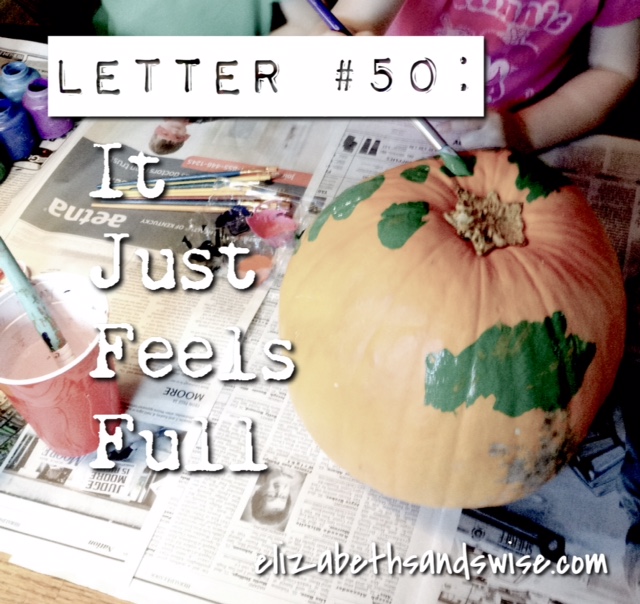
I want to enjoy the swingset in the cool breeze, taking you out on a run without having to slather you in sunscreen, painting pumpkins and maybe even that random decorative squash a friend gave us that is shaped like a character out of Veggie Tales. I don’t want to start counting down to Christmas, and worry about what our travel plans are for Thanksgiving, and Christmas lists and gifts and painting a Jesse Tree.

It’s too much, it’s too fast, the calendar is too full. It stresses me out.

Well, it does when I look at it that way.

But sometimes I don’t look at it that way.

I glanced at my monthly calendar this morning and was astounded at All The Things on the schedule. It’s felt a little hectic the last few weeks, and no wonder. It has been.

All The Things distract us and keep us busy, All The Things pile up and wear us down, All The Things fill up our weeks, our semesters, our days, our moments.

But there was a moment of grace this morning. I felt a distance when I looked at the calendar because I realized that All The Things are things we do; they are not the things we are. They are what we do but they do not determine the way we do life.

I am more convinced than ever that a full life does not have to be a stressful life. A full life does not have to feel like a “busy” life. Full might mean doing a lot of things–or it might not.

It’s more like a way of approaching the things on the calendar. Because the calendar will be full regardless.

A full life is about being present.

Being attentive in the moments.

Breathing.

Enjoying the warm breeze, or the cool breeze, the feel of those soft mum blossoms as I water them every day. My mom tells me that’s how you keep them alive.

For me, it’s taking the time to write, to make art, to create, to paint. It’s reading a novel instead of watching TV. It’s putting down the novel to set you up to paint a pumpkin.

I was astounded last week when I sat down to go through these fifty letters and the poetry I’ve written over the last four years, to sift through the words I’d forgotten I’d written in order to share some of them publicly at a poetry and art night at our local arts and cultural center. Girls, there were so many words. I’ve written so many words. But I’ve been so tired for four years, girls. So tired. How could this be? It perplexed me. It still does.

Being present means seeing the way grace is already present in my life.

Being present means slowing down to really see beauty.

Because when I slow down in the moments, the days slow down too, the whole life slows down.

The busy-ness becomes full-ness instead. The activities become separate from the way we feel about the world.

And that full-ness, even when I’m bone tired, becomes happiness.

That sounds trite, doesn’t it? To say that I’m happy?

Of course, I’m worn out and frustrated and on the verge of losing my temper a lot of the time, too, more times than I like to admit, but when I do that whole being-attentive-thing? There is peace there. There is happiness.

Don’t get me wrong, the truth is, I didn’t really want to scrape Cinnamon Life out of the carpet this afternoon. But I did it. And for some reason, as I sat on the floor, there was peace there.

I did not like extending my shopping trip to WalMart yesterday by stopping in the bathroom for a potty-training two year old. But I did it. And, okay, there was not peace there. You spilled my purse on the floor. But there could have been, I can see that. If I hadn’t lost my temper.

I haven’t really wanted to read a Harry Potter book every week for the last four weeks. But I’m doing it. Making space for these enormous books in my life—750 pages this week, girls–means making space for good discussions in our house on Thursday nights with college students and friends.

I didn’t want to do my freelance work from a desktop computer tucked halfway into a hall closet last week when our ethernet cable went bad, but I did it. And even found it amusing at times, working in a linen closet.

Most days, I don’t want to rise early to have some quiet before you wake up, and some mornings I don’t, but some mornings I do.

I don’t like to wash the dishes or do tedious chores like folding laundry, but when I’m willing to see grace here, I’ve found in that tedium surprising moments of meditation when I’ve least expected it. I was asked at my poetry reading about inspiration and writing habits, and I realized that most of my ideas for poems and blog posts come when I’m chopping vegetables.

This, girls, is a happy season. It’s a tiring season. It’s a full season. There is much to do and places to go and ministries to serve and friendships to build and art to make and you to love and hold and snuggle and teach.

Sometimes it feels stressful, if I let it.

But most times, it just feels full.

And happy.

Love,

Your Momma

The Forty-Eighth Letter: I Need Reviving

img_8839

Dear Daughters,

Tonight our church is kicking off a revival weekend: three evenings of dinner and revival services that culminate in our Sunday morning worship service and potluck after church.

Sigh.

I should probably say up front that I wasn’t raised Baptist, and I feel a bit ambivalent about these planned revival events in general.

Probably because of the charismatic strain of my childhood—in which we said we expected the spirit to move any given Sunday—it’s hard for me to wrap my brain around a planned-out revival. Though I’ve been told that these are totally normal things for a church such as mine, I’ll confess it’s hard for me not to be doubtful.

Over the last few days, though, I’ve been feeling a good old Pentecostal nudge about it. Here’s what that nudge is telling me:

We need reviving.

And, what’s more:

I need reviving.

Last week, during a meeting with one of our ministers, I broke down in tears because the church feels broken to me. Like we’ve got it wrong and I don’t even know how to change things. Like I don’t have the energy to even imagine how church could be different, how new life could be breathed into dry bones. (Look at me getting all Scripture-quotey.)

Hear this, girls. I’m not trying to be down on our particular local church. This is a community who loves you and teaches you and smiles at you and can’t believe how big you’re growing.

What I’m trying to say is that I have this gut feeling, this uneasiness, that the church as a whole is broken.

The way we tend to do church—and by “we,” I guess I mean everyone who has experienced church as I’ve experienced it, which certainly isn’t everyone, not even everyone at my own church, but I would guess is a lot of thirty-something Americans who grew up broadly evangelical—the way we do church doesn’t seem to be getting to the heart of Kingdom-of-God work. We make due with how church is because it’s always been like that. We are used to it. We don’t even expect it to be more, to be the place where we experience the presence of God. Yes, the presence of God. Look at me getting Pentecostal.

I think a lot of us do a lot of good in our individual lives, a lot of us have these hands-and-feet-of-Jesus convictions, but I rarely see faith communities living out being the body, being a community that draws people to God, that welcomes the stranger, that cares for the orphan and the widow, that feeds the hungry, heals the deaf and the mute. I don’t see us doing much of that literally or metaphorically.

Sigh. Maybe I just don’t have eyes to see. Or ears to hear.

As I said, I could use some revival.

I’ve been studying Mark lately, and Jesus is just so radical.

And so I was crying tears of frustration and sadness and broken-heartedness, because I want a community that selflessly and radically gives to one another and to the world, a community that is vibrant and happy to join together on a regular basis because we are Just So Darn Excited to be gathering and worshipping, to be learning and teaching, to simply be sharing in the presence of God.

That presence of God would call us to radical lives, girls, not just shuffling-kids-to-soccer-practice lives.

That presence of God would draw the stranger to us, and we could be welcoming angels without realizing it, rather than weighing the pros and cons of snappier music during our services. (Don’t get me wrong–I wouldn’t mind a little more toe-tapping myself.)

Sigh.

Here’s the truth. When I try to get you excited about church on Sunday mornings—yay! Sunday school! Yay! Nursery! So fun!—it’s a show. A show.

I don’t feel that excited on Sunday mornings, truth be told, and by the looks of most people in our church—the harried parents, the lonely widowers, the distracted businesspeople, the college professors, the worn-out staff, the kids running to get donuts—I don’t think most of them are excited about being present either (except maybe those kids who really want the donuts, you two included).

Most of us are there because we are there.

And so… revival.

Seems like a good idea to me.

Let’s go get us some.

Love,

Your Momma

The Forty-Fourth Letter: I’m Still Patriotic

IMG_2152

Dear Daughters,

A half dozen years ago or so, I received a phone call from a federal agent because a friend of mine worked for the government and needed security clearance. The government was looking into her history, which had involved much time spent overseas, and so the agent wanted to ask longterm friends about her. I was happy to chat with him because my friend is top-notch: brilliant, amazing, compassionate, and talented.

In the midst of our long conversation–it was a lot more thorough than I had expected it to be–the agent asked if I would use the word “patriotic” to describe my friend. Patriotic.

“They asked me if you were patriotic,” I told her later.

“They did?” she asked me. “What did you tell them?”

It’s such a strange thing to evaluate about someone else.

Because my birthday is just before Independence Day, I’ve always had a soft spot for fireworks and the red-white-and-blue combination of colors.

Whenever I’m in an airport going through customs, I feel a little twinge of pride to be able to queue up in the “U.S. Passport Holder” line.

My grandfather was a 101st Airborne paratrooper in World War II, and he earned a Bronze Star for defending a bridge with a bazooka. By himself.

I was raised in a family that votes, and I vote.

As a kid, we went on myriad Washington DC daytrips from central Pennsylvania and saw the famous monuments, went to the Smithsonian Museums. I remember my dad lifting a woman up so she could trace someone’s name from the Vietnam War Memorial.

I remember singing “Danny Boy” as part of our high school honors choir concert at a local church for Veterans Day.

I never had a problem saying the Pledge of Allegiance in high school. I was, however, less than thrilled with my fellow students who not only did not say the Pledge but refused even to stand.

Here’s a random side note: because our high school principal, who led us in the Pledge over the loud speaker every morning, didn’t pause after “nation” in the typical way of most Americans (“one nation [pause] under God [pause] indivisible [pause]….”) and instead said “onenationunderGod” quickly, I still say it differently than most people.


Though I don’t come across as very political, these days, I’ll confess I’m still sentimental about songs like “Proud to Be an American.” My Uncle Larry always sang it back when we were part of the Family Circle, our family’s traveling gospel group.

The thing is, I am proud to be an American.

The other thing is, I think Americans get a lot of things wrong.

But it doesn’t mean I’m not patriotic, not a good citizen.

I am patriotic.

And I’m a political moderate. At least, I assume I am a moderate because about half of what I hear from one side sounds crazy and about half of what I hear from the other side sounds crazy.

To listen to the news, you wouldn’t think that I exist. You’d think there were only extreme views of conservative or liberal. I even hear this among my friends who feel strongly about politics, by the way. Everything is us versus them.

I don’t know what happened to an America that allowed for a diversity of voices, but it’s not today’s America as far as I can tell.

Girls, there is a lot of unpleasantness in the political news cycle these days.

That’s the understatement of the year, by the way.

Many months of political campaigning has culminated in the Republican National Convention this past week. The Democrats will have theirs next week. The upcoming fall is guaranteed to be nasty and cruel. We’ve succeeded in choosing two of the most polarizing candidates in American history. So many accusations. So much hostility.

So much unhappiness.


I’m tempted toward fear and anger sometimes, embarrassment sometimes, sometimes just paralysis because a remedy seems impossible.

But then I hear the preschooler recite the Pledge of Allegiance, which I’ll confess it had never crossed my mind to teach you. You learned it last fall at your twice-weekly preschool at a local Baptist church. You pause after the “one nation” like all good little Americans do. One nation. Under God. Indivisible. With liberty and justice for all.

And then at the end, right after “justice for all,” you raise your voice and begin singing.

AMEEEEEEERICA, AMEEEEEERICA,

God shed his grace on theeeeeee,

and crowned thy gooooood

with br00000otherhood from sea to SHINING SEA!


And in the in the midst of that off-key loveliness–especially since for many months you sang “motherhood” instead of “brotherhood”–how can I not be patriotic?

How can I not think about my grandfather risking his life with his bazooka poised to take out a tank singlehandedly? How can I not be grateful?

How can I not think of the woman on my dad’s shoulders, tracing a loved one’s name? How can I not be grateful?

How can I not remember the Lincoln and Washington Monuments, the Smithsonians? How can I not be grateful?

How can I not hear Uncle Larry singing “I’m proud to be an American, where at least I know I’m free”? How can I not be grateful?

I am patriotic. I am a political moderate. And I know that the double stroller doesn’t fit through the door of our polling location–because I vote.

But I always give you the sticker.

Love,

Your Momma