The Forty-Sixth Letter: Pappy’s Old Shirt

IMG_6660

Dear Daughters,

When I was back in Pennsylvania last spring, my grandma gave me two of my pap’s old shirts. One is thick and flannely, an assortment of grays and blues in plaid, and the other is thinner, a turquoisey green with a small stitch of pink throughout. There are a few stitches of white at the corner of the pocket where Gram repaired it at some point. She told me this was one of her favorites of his shirt collection.

I slip it on sometimes when I need to rock the baby and I don’t want my sweaty skin to keep her from drifting off to sleep.

I wore it last week while in Santa Fe at an art workshop.

A little while ago, a strange thing happened. As I grabbed the shirt from my closet, a series of quick thoughts ran through me. This is Pappy’s shirt. Why do I have one of Pappy’s shirts? Oh, that’s right, Gram gave it to me. Why? Because Pappy passed away on Christmas Eve. Really? He died? Yes, I went to the funeral. That’s right. The funeral.

That’s strange, right? Being confused about the death of a beloved family member? I mean, I wrote about the funeral and how Pappy was such a badass who had lived a life of transformation.

So of course I know that he passed away. I know it. Of course.

But for that brief moment, it was as if I didn’t know it.

For the last sixteen years, I haven’t lived in the same state as the majority of my family members for more than a few weeks at a time. Still, our family, all branches of it, feels really close to me, because I grew up around most of my cousins and aunts and uncles and grandparents.

But I don’t live close to any of them now, not physically, and so I miss out on the day-to-day memory-making that comes from family in community. The whole in-your-business-whether-you-want-them-to-be-or-not phenomenon. I don’t have that.

And I miss out on having those family members getting to know you, girls, and watch you grow and change, which I’ll confess makes me a little sad.

But I also miss out on something else. I miss out on missing those who have died, I miss out on the gap that comes into a life when a loved one is no longer present.

It’s not that I don’t mourn and grieve, I do. I am a cry-er, and I’ve spent lots of time crying over loss. But sometimes I am startled to realize that I live inside a memory that keeps them alive.

That sounds kind of weird. I just read it out loud. Let me try to go about this another way.

When I welcomed my neighbor into our house for tea this week and poured boiling water into Grandma Wise’s green teapot, I thought of my friend Katy from Texas. She had me over for tea dozens of times during our years in Waco. Yesterday, pouring dark black tea into the matching green mugs, I remembered Katy’s teapot stand that kept her pot heated by a burning tea light candle, and I thought to myself that I should get one of those, and as I thought that, it felt as if Katy were still alive. It was as if I had forgotten the news of her death, as if I could open the mailbox today and receive a letter from her, addressed to me in her loopy cursive script. She passed away four years ago.

When I make the bed in our guestroom upstairs, and I shake out the blue star-patterned quilt my grandma made me as a wedding gift, I think of her, and I often forget that she’s been gone for seven years this fall. Seven years. I might have been the last of the grandchildren to get a quilt for a wedding gift. We’ve been talking about her a lot recently because it’s sweet corn season and you both love corn pancakes. She used to make them for me when I was a little girl.

When I go back to my in-laws’ house, I often expect to see Oma or Opa come wandering out from the new addition where Mimi and Papa now sleep. It’s not even a “new” addition any more, but in my mind it is where the great-grandparents still live. They were both gone before the baby was born. 

I can imagine Beanie rocking in the big recliner in my dad’s living room. I think of the room where your dad and I sleep while we visit that house as Beanie’s room. She died before you both were born.

I know the apartment where Uncle Stephen lives was built originally for Pappy Sands, and when I think of that living space, I think of eating dinner with Pappy toward the end of his life. He called me Betsy, I think, or maybe Betty, during that last visit, and I didn’t know if he was trying to be funny or not. But the thing is, it feels as if he’s still there.

I am surprised repeatedly that your dad has never met Ginny, one of my beloved grandparents, who died while I was in high school. She’s still so alive in my memory, her tapioca pudding, her chocolate chip-heavy cookies, that she must still be living. That’s how it feels. She must be. Your dad probably feels like he knows her, of course, for as many times as I’ve mentioned her.

That’s the way memories work, I suppose. Or maybe just my memory works that way, because of my love of a good story, of strong memories, of family, of loving deeply, of being empathetic and overly sensitive in all the good and bad ways.

So.

Maybe I’ll continue to be perplexed when I grab Pappy’s shirt out of the closet. I’ll have that split second of confusion, unsure why I even have this shirt in my possession.

Or maybe, someday, it won’t seem strange that he’s gone.

But regardless, I’ll be thinking of him when I wear the green shirt with the pink stitching, the repaired pocket, the thin cotton. And though it seems cliche to even write it, I’ll be keeping him alive in my memory. And in your memory of my memory.

Because I’ll be telling you the story.

That’s what I do.

I wear stories.

I tell stories.

I live stories.

I suppose it’s how I do my remembering.

Love,

Your Momma


The Forty-Fifth Letter: Funerals & Eulogies

IMG_9677

Dear Daughters,

I’ve been to a lot of funerals in the last few years. Between your dad and me, we’ve lost six grandparents since moving to Kentucky. That’s a lot. And our church community has lost a significant number of members in recent months.

So I’ve been to a lot of funerals in my life.

And I’ve heard a lot of eulogies.

A friend of mine who is a few years older than I am–so she’s in her late 30s–told me she has never been to a funeral.

Talking with her got me thinking back to the funerals of my childhood. The first one I remember was the funeral of my maternal great-grandmother: Grandma Ebersole. My memory of her is mostly of the later years of her life, when she was small and frail and lived with my grandma. She dressed plainly, I believe with a head-covering. Her hair was white. She was little in stature, and for me to think that, given that I was a child, albeit a big child, is telling. She must have been small.

I don’t remember much of that funeral, except that there were distant relatives around and it’s the first time I remember becoming aware that my mom had cousins and used to be a kid once, just like I had cousins and loved to play with mine.

My great-uncle “Woody” died when I was a little bit older. He was my paternal grandma’s brother. And also my great-grandma Woodward, my paternal grandma’s mom, passed away. Because they both had lived in Ohio, and I used to visit them both in the summers along with my cousin Angela, those funerals run together a bit. But I was old enough to feel those losses as someone who, well, as someone who remembered.

At Grandma Woodward’s funeral, the Family Circle sang. My dad offered the eulogy. I remember hearing my dad’s voice breaking, and realizing again the way intergenerational relationships work–he had been this woman’s grandson, and she had been his grandma, and he had been a boy once, and that meant that my grandparents would die, and I would be a grown-up with my voice cracking as I remembered their lives, too. Some day.

I am now that grown-up.

I still tear up when I try to talk about my grandparents who have passed away.

I’m tearing up now, just writing about it.

(This probably won’t surprise you, when you’re older, because already you see my cry all the time, over books or articles or sad news or happy news, and you come over to me and rub my arm or my back to offer comfort in the only way you know.)

I’ve attended funerals as a family member of the deceased, and I’ve attended funerals as a friend of the deceased, and I’ve attended funerals as a mere acquaintance, which makes it sound less than what it is–a member of the community that did everyday life alongside the deceased.

The last two funerals I’ve attended have been that kind–funerals of folks I know through church, who have had an impact on me because of their service to our congregation and to the wider community. I knew these women as strong and courageous and independent. I knew them as encouragers who always asked how I was feeling when I was pregnant, who checked in on me when you both were born, who always commented on how big you were getting.

But I didn’t realize how little I really knew them until I went to their funerals. I only witnessed, in my years here in Kentucky, a small glimpse of their whole lives. It was an inspiring glimpse, but it was only a small fraction of their story.

They had both lived such incredible stories.

And we live in a small town, so their stories affected so many other people’s stories.

That’s what you find out at funerals.

You go from knowing how a person interacted with you to knowing how she changed your whole community.

My friend who has never attended a funeral told me she feels a little morbid about attending funerals, like when people she knows lose loved ones and she wonders about whether she should go. She feels like it’s kind of weird to watch others who are mourning.

I don’t feel that way. In fact, as I sat in a funeral at our church last week, listening to the stories of a life that had worked to bring about the Kingdom of God, I thought to myself: I should really attend more funerals.

Maybe that’s how we can learn to be better human beings.

Maybe that’s how we can witness the genuine loss that every death brings to a community.

Maybe that’s how we participate in the beautiful heartache that is life in community, the sacred ordinary of life lived alongside others, the scars we feel on the hands and feet of Jesus as we offer our own hands and feet to the world.

And maybe that’s how we start thinking about what our own eulogist would say about us.

Love,

Your Momma


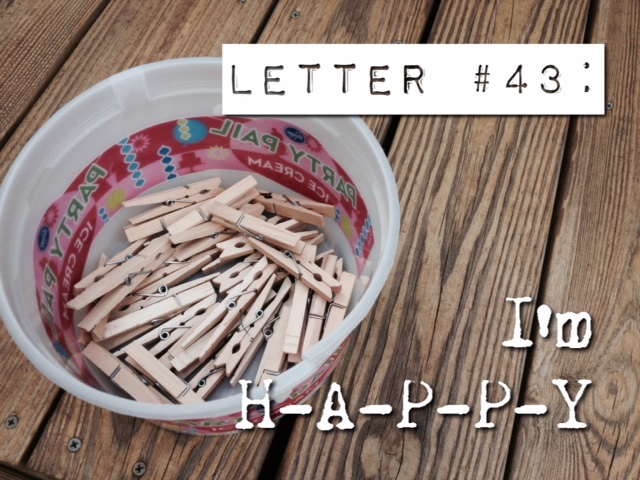
The Forty-Third Letter: I’m H-A-P-P-Y

IMG_6268

Dear Daughters,

The baby girl has begun announcing in the morning that she’s happy.

It always sounds out of the blue: we get you out of your crib, we change your diaper, try to tame the bedhead, and then you snuggle with one of us and announce, “I’m happy.”

I think it’s because you’ve heard us say, “She woke up happy today.” But it might also be because your grandma taught you a song that goes like this: “I’m H-A-P-P-Y, I’m H-A-P-P-Y, I know I am, I’m sure I am, I’m H-A-P-P-Y.” And then it ends with a shout: “HAPPY!”

It’s sung to the tune of “The B-I-B-L-E,” and honestly, it’s kind of annoying.

But we sing it. A lot.

And now you tell us every morning that you are happy, which, I’ll confess, is really sweet.

This morning, I was writing a newsy e-mail to some friends I haven’t seen in a long time. I was listing the various things I’ve been up to, the various things we’ve been up to as a family. When it’s all typed out, you know what? It sounds pretty impressive, like I do lots of cool stuff. I’m doing this copyediting and that writing, I’ve been making art about this and that, I’ve read this book and that book, and am involved in this activity here and that activity at church, and we went on this trip and that trip, and I’ve been running a lot. Literally and figuratively. Ha. The list of All The Things We Do was so long.

And then, I’ll confess, I wanted to write this:

And yet, somehow, it feels like all I ever do is hang laundry and wash dishes.

Because that’s the truth. That’s what it feels like.

Many days, the drudgery of the days outweighs the beauty of the days.

If I let it.

But there is so much beauty here. I can’t say that enough.

I have to say it in these letters, I have to say it to you, for you to read someday, because I doubt I’ll remember it.

I have a hard time remembering it from day to day.

There is beauty here, if I look for it. And I am happy.

A friend of mine has three children, the oldest heading into kindergarten. I had you girls at about the same time she had her youngest two. We were pregnant at the same time both times. Sometimes I look at her–she takes all three children to the grocery store at the same time! she has driven all three children by herself to places in other states!–and I think, how does that woman do it? How does she ever leave her house? How does she remain sane?

And then I see friends who have children and work outside the home full time, and they appear put-together and organized–showered and everything!–and we have conversations suggesting they get a lot more accomplished than I do in a given day, and I just don’t know how they do it.

I don’t know how they do it.

Sometimes I look at my friends without children, or those who aren’t married, and think they are living the life. Such freedom! Such motivation! Such achievers! They are changing the world, making a difference I can point to.

I know, I know. You can’t ever know what it’s like to be someone else. And it’s so ridiculous to try.

Here’s another clothespin, by the way. I’m standing here in 90-degree weather, dripping with sweat, hanging up a heavy, wet T-shirt on the line.

Another mom-of-three friend of mine has a chronic illness. She inspires me every time I talk to her. But last week, she told me how amazing I was. Me! I forget why. I think maybe I told her about trying to write a poem a day for the month of June. She’s in my writing group. She told me she was amazed at everything I was able to get done.

Me. She told me this.

My college roommate once told me she thought I was “living the life.” This woman has a decidedly amazing job and lives downtown in a major city. How can I compare with that? I was making zucchini bread when we were talking on the phone, and I was telling her about my Artists Way class, and the art I was making,, and that’s when she said it.

Say what?

What I do is not amazing, I wanted to say.

I am not living the life, I wanted to say.

All I do is hang laundry and wash dishes, remember?

But GIRLS. That of course isn’t true.

Your mom is amazing.

Our life is amazing.

There is such beauty here.

I’m H-A-P-P-Y.

I get to make art and read books. I get to write and sneak your watercolors when you aren’t watching. I get to make a cup of tea (or three) and do my freelance work in my pajamas if I want to. I get to snuggle with you and get the icepack out when you fall once again and bonk your head on the little desk in the living room. I get to teach you to say, “May I please have one minute?” instead of “NO!” when I tell you it is time for quiet time. I get to answer your incredible questions–how does a giraffe sleep? what holds our bodies together?–and let you listen to my heart with your pretend stethoscope.

And, well, I get to hang laundry. A lot of laundry.

But I’m happy.

And pretty tan from all that time in the sun.

Love,

Your Momma

The Thirty-Seventh Letter: Generations of Women

IMG_5395

Dear Daughters,

Yesterday, as I picked up a frowning, teary, and inexplicably needy just-turned-two year old, I heard myself asking her, What’s the problem? The way I said it was comforting, not accusing, a question more along the lines of, How can I help?

As baby girl leaned her face into my neck, pulling herself tight against me, I asked again without thinking about it: What’s the problem?

Then something surprising happened.

In my head, I heard the question repeat in my maternal grandmother’s voice. Clear as day. As if I’d heard it a million times before, though I don’t have any distinct memories of her saying it.

And then, as I listened to the reverberations of her imagined voice, I heard my mom’s voice saying it, too. What’s the problem?

I listened more, still holding baby girl, who had wrapped her legs around my waist, and the two voices–my grandmother’s, my mom’s–became indistinguishable.

Because they’re nearly the same voice.

Sometimes when I’m on the phone with my mom, I hear in my mom’s voice the distinct intonation that was my grandmother’s. Actually, I hear it most clearly when I listen to her speaking to you, probably because what I’m remembering is the way my grandmother spoke to me.

I remember once as a teenager listening to my mom and her three sisters visit during a holiday gathering. They all had the exact same laugh, it seemed to me, and even twenty years ago, I recognized in it my grandmother’s laughter. Grandma was still alive then.

Sometimes, when I answer the phone, your dad says to me, “You sounded just like your mom.

Sometimes, when I answer the phone, I myself can hear her voice come out of my mouth.

We named the eldest’s first babydoll “Elsie” because my mom’s first dolly was “Elsie” when she was a little girl. We have a photograph of my mom and her Elsie back in the 1950s. It’s amazing to me that Mom’s bright eyes and round cheeks foreshadow yours so strikingly, girls.

So much of what I think of as “me” as a child, I see in you. And the older I get, the more I realize much of the me part of me is really my mom. And that part of her has a lot to do with her mom.

Mother’s Day was Sunday. Yesterday was my mom’s birthday.

A few years ago, one of my dad’s sisters came to visit, a woman who of course had known my mother well when Mom was my age. They’d sat in many a church pew next to one another. While in town, Aunt Diana went to church with us, and later she told me that sitting next to me in the pew was like sitting next to a young Bonnie. She said my mannerisms were the same, the way I sat, the way I crossed my legs. Those details were just like my mom.

Nobody had ever mentioned those likenesses to me before.

Last weekend, I put a new pair of stretchy jeans on and stood before our full-length mirror, something I don’t do very often. I saw my mom looking back at me. I’m a lot taller than Mom, but it was uncanny. In fact, I came down the stairs and told your dad, “I look just like my mom.”

Girls, you and I come from strong women. Women of courage.

My grandma died before you were born, and because it was important to me that the eldest carry her name, I hear myself saying Grandma’s name all day long, day in and day out. And Grandma’s voice echoes to me each time I see you print those five letters on your artwork. You are so proud of being able to write your name.

In those early, hazy days of being a mom, when I felt like I was sinking rather than treading water in the ocean of parenthood, one of the few things that brought me comfort when rocking you or nursing you or bouncing you on the yoga ball was doing a very non-Protestant thing.

I talked to my grandmother about being a mom. My grandmother who was deceased.

I asked her to pray for me.

She had six kids, and the first three were really close together. I thought she must have known a thing or two about how I felt, exhausted, hormonal, focusing on getting through the minutes because the day as a whole was too overwhelming.

My mom was her firstborn. My first name is Grandma’s middle name.

I figured if Grandma could get through this thing called motherhood and end up the sane woman I knew her to be when I was a child, she could help me get through it, too.

And she did.

My mom tells me that the first time I crawled, it was because she was catering a meal at a church and was busy in the church’s kitchen. Mom had left me down the hall in the nursery, and she could hear that I was crying, but she couldn’t stop what she was doing and come to me. In a little while, here I came, still crying, but crawling out to find her.

I love that story.

Maybe the ending goes something like this:

Mom sees me crawling and crying, my face red and frustrated, my bottom lip sticking out the way both of you do when you’re sad. She washes her hands and walks over to me, and I pull myself up on her legs to stand. She picks me up. I lean my head on her shoulder, pull my body in tight, and wrap my legs around her waist. She rubs my back and asks me, her baby girl, “What’s the problem?

And maybe she hears her mother’s voice.

Love,

Your Momma


The Thirty-Fourth Letter: Where, O Death?

IMG_8544

Dear Daughters,

We live a few blocks away from a funeral home, so I’m reminded every other day or so of the reality of death and suffering. On long walks, we pass by cars full of mourners, with you two happily in the stroller eating your snack, oblivious to what’s going on. On our way to head out to eat for dinner, on the way to Lowe’s for a quick construction run, on my way to reading group, heading to a playdate, picking up your dad from work when it’s raining: those who have experienced recent loss are nearly always present. I drove by black-clad mourners on my way to get a soy latte this morning.

I have always found this reminder of death in the midst of life helpful. It’s a proverbial wake-up call each time, that whatever is on my mind or burdening me at the moment is fleeting and that there is real suffering all around me.

I love our church’s Easter tradition of carrying lilies down the center aisle in memory of loved ones who have passed away the previous year. The preschooler carried one this year, in memory of my grandfather who died on Christmas Eve. The plant swayed as she walked, but she made it safely to the altar.

As the lilies pile up in the front, filling up the absence left when the altar is stripped at the end of the Good Friday service, our congregation stands and sings “Christ the Lord Is Risen Today.” I can never sing the song, of course, because as I watch my friends carrying down lilies–or those years I’ve carried them down myself–I think of all the loss we’ve experienced as a community. I think of all the meals we’ve delivered. All the prayers we’ve prayed.

My throat catches, and I don’t sing. Our loved ones die, and we feel so much pain.

The lyrics to many of the great Easter hymns, including “Christ the Lord Is Risen Today,” have a line or two echoing the sentiment of 1 Corinthians 15:55: “O death, where is thy sting? O grave, where is thy victory?” (sometimes the King James Version just says it best).

I counted at least three references to that verse in the songs we sang Sunday morning. And, I’ll confess, it kind of annoyed me each time.

A friend of mine who lives many states away texted me an update about her dad, who is having significant health problems and was in ICU. She was travelling back from visiting with him, and she concluded with, “I’m exhausted and sad. But He is risen, so there’s that.”

So there’s that.

Where, O Death, is now thy sting?

One of my strong and beautiful friends lost her husband suddenly last year. She carried a lily down the aisle at church.

Where, O Death, is now thy sting?

A vibrant 26-year-old mother in our town was diagnosed with two forms of terminal cancer this week. She was given three to six months to live.

Where, O Death, is now thy sting?

I can tell you where. It’s right here.

Right.

Here.

People are hurting all around us, girls. It is hard to live in this world and know pain and love people who know pain. And we get numb to these words of Scripture–O death, where is thy sting?–and it kind of makes us, okay, me, mad. Or sad. Or frustrated. Or helpless.

All of it.

Sometimes I think we sing Where, O Death, is now thy sting? followed by Alleluia (adding a little salt in the wound) without remembering that many among us don’t feel encouraged by the creeds. And I’m talking about those of us who do have faith in eternal life, who do sincerely believe that eternal life brings relief from suffering. We know it intellectually, and we might even know it on a deeper level, but it doesn’t always ring true to experience.

What we feel is the very real sting of death.

The very real sting of our loved ones being diagnosed with cancer. Of babies dying. Of marriages crumbling.

I have faith, girls. Most days, I have it in spades. But I have faith alongside a healthy dose of reality, which is that life in this world hurts a lot of the time, and I don’t want to pretend that’s not the case.

I am careful when I write condolence cards because it’s too easy to be trite.

Of course, Easter reminds us that death does not get the last word. I appreciate that message. But I think we need to be careful where we go from there.

Easter does not tell us that we won’t feel the very real pain of losing loved ones in this life.

We can believe and have hope in eternal life and in the good God whose own creation sings praises, while we also say, no, I’m sorry, there is a sting of death.

Part of me hopes that you feel the sting of death a lot, girls. Because that means you’re really living in the world and loving people.

And I hope when you see full parking lots at funeral homes, you are able to pause and reflect on the death and suffering that coexist with your own lives, that trump your own annoyances and frustrations and pride and self-centeredness.

But I also hope that when you see Easter lilies, you remember why we carry them down the aisle on Easter morning. I hope you remember this little nugget of the truth of Easter that sometimes gets buried: even when we’re sad and exhausted, He is risen.

Because there’s that.

Love,

Your Momma


The Twenty-Fourth Letter: Gratitude and a Full Life

letter 24

Dear Daughters,

Life has been full.

I don’t like the word “busy.” Everyone is busy. Busy is overcommitted, flustered, multitasking, doing, and going. Busy is the struggle to find time that doesn’t seem to be there.

Full is in making time.

Making time for a full life is staying in bed to cuddle with a sweaty child who arrived in the wee hours of the morning instead of rising early to write my morning pages.

A full life is playing pingpong while a preschooler circumnavigates the table. It’s cinnamon sugar cookies for a trivia night fundraiser, campfires and s’mores on Saturday night, Sunday morning bran muffins, and a Mary Kay open house.

A full life is hot black tea with milk and sugar every morning, children who take ages to finish dinner, dealing with congestion at 4 am…getting another cup of water, dosing Benadryl, falling asleep on the couch with a no-longer-lap-sized baby breathing heavily through the timer light kicking on at 5 am. It is a de-scaled humidifier, abhorring Wal-Mart but going there anyway, and eating lunch at Chick-fil-A so often the three-year-old says “my pleasure” instead of “you’re welcome.”

A full life is a child who sings “Through many dangers, toils, and snares…” as well as “The doc is in, and she’ll fix you up…,” who asks beautiful questions about Jesus being in her belly, and says spontaneously, “All of the days I love you, Mom.” A full life is a baby who shrieks “Yay!” when I tell her that Daddy is on the way home, who “counts” for Hide-and-Seek like this: “Nine…Nine…Nine…Nine…”

A full life is leading a women’s Bible study, meat-heavy Wednesday night dinners at church though we’re primarily vegetarian at home, looking forward to Advent, gifting spray-painted mason jars.

A full life is a preschooler who says her mom’s job is “artist.”

A full life is a 12-week Artists Way class winding down, writing an Advent devotional, a poem about cardamom, getting inspired at the Peddlers Mall.

A full life is signing up to bring Crockpot macaroni and cheese to the preschool Thanksgiving feast, a child who remembers her Sunday school lesson about the Ten Commandments, who out of the blue said “Saul was good at being good” (quoting her children’s Bible), who continues to think that Goliath is the best Bible story, who can write her name and spell her sister’s name.

A full life is taking the time to go to the library, to spell out words and practice letters, to collect leaves until every window and arch is covered with construction paper leaf flags. A full life is a monthly reading group at Panera, buying fundraiser items from the neighbor kids, loving on Lulu-the-Cat, our neighbors’ pet who lives in our yard and prefers our porch to hers. A full life is scarves and gloves and snotty noses outside but going outside anyway. A full life is too dark at 6 pm to go running on uneven sidewalks covered with leaves.

A full life is the large tupperware on the toddler’s head, a homemade grape costume and comments about Fruit of the Loom, and a list of gratitude for November.

A full life is being grateful for the simple things that make up a full life.

A full life is a grateful life, girls.

A full life is gratitude.

A full life is grace.

Love,

Your Momma

The Seventeenth Letter: My 33rd Birthday

photo (9)

Dear Daughters,

Today is my 33rd birthday.

When I was pregnant the first time around, I attended a (very) brief set of classes for expectant moms at our local hospital. Of the three other young women in the class, all of them looked about twelve to me. They were probably more like 18 or so, but I was nearly 30. That’s a pretty big difference. I was the only attendee who came with questions about hospital protocol and expectations, and I’m guessing the only one with pretty strong feelings about her birth plan. I might have been the only one who was married.

At my next doctor’s appointment, I asked my OB if I was old to be having a baby. He said no—he had lots of patients much older than I was. But when I told him about how young the other women seemed in the hospital class, he qualified his earlier statement: “I guess you are relatively old to be having your first baby.”

My mom was in her late twenties when my brother was born; she’d just turned thirty a few months before I came along.

So this age feels about right to me, though I admit that it would have been easier to bounce back physically after your births if I’d been ten years younger. (After the first unmedicated labor and delivery, I felt like I’d run a marathon without any training.)

Yes, there are reasons for having babies young that I can only appreciate now, now that I’m not young. If I hadn’t lived a childless, adult, happily married life for 8 years before you were born, for example, I’d probably mourn that life of freedom a little less than I do.

But I wouldn’t change it if I could. I like my thirties. I like raising you in my thirties.

I’m more reflective and laid back as a parent than I would have been in my early twenties; young people fresh out of college have such fervent convictions and clarity. Granted, I still have conviction—and I probably voice that conviction more than the average person—but I’m gentler than I was ten years ago. And I hope more patient.

I hope.

I’m probably as stubborn as I ever was, and I still worry a lot, but I have a lot better grasp on the things that really matter.

And the things that don’t.

I’m still easily distracted and can’t multi-task, but I know that relationships with people are more important than finishing the book before my weekly reading group.

I’m better at appreciating beauty in normal, everyday life, but I’m still a far cry from thinking that motherhood cultivates grace. I don’t see grace here, and I’m fine with saying so. That’s probably something an older parent is better at, too. In my thirties, having lived my last decade in a different season, I’m comfortable with knowing that this season, like that earlier one, won’t last forever. It makes me grateful, but still exhausted.

I’ve enjoyed growing older and getting grayer alongside your dad, who continues to inspire me, and I will enjoy growing older with you. You’re transforming into little independent people already.

The summer I turned thirty, just after the Bean was born, I remember telling my mom that I couldn’t believe I was in my thirties now. She told me that she couldn’t believe her baby girl was 30 either! We laughed together at the time, but I realize more each day just how honest that feeling is.

That day—when my own baby is 30—will be here for me before I know it. And I’m not exaggerating when I say that at some point every day, every slow and boring and life-sucking day, I am paradoxically astounded just how quickly the overall time is soaring by.

I had no idea that watching children grow and learn and develop and change would be such a reminder of how much time is sifting through my fingers.

I’ve never felt angsty about aging—not about going gray, not about the freckles and age spots, not about the creases around my eyes.

But it still catches me by surprise when I glance in the mirror.

I am 33.

Young.

Not young.

Just right.

Love,

Your Momma

The Sixteenth Letter: Eleven Years In

phonto-3
Dear Daughters,

Eleven years ago today, your dad and I got married in a tall stone church on State Street in Harrisburg, Pennsylvania. It was a hot June weekend in the Susquehanna River valley, and the roads near the church were roped off for a race. I saw family members who’d gotten stuck in traffic sneaking in just before I walked down the aisle.

We said in our wedding vows that we would serve God together, side by side.

Side by side.

Side by side for eleven years. Towering over most other human beings.

Two states, three graduate degrees, two apartments, two houses, four cars, two daughters, in eleven years.

We’ve lost five grandparents and found four nephews and two nieces in eleven years.

We’ve sanded down hardwood floors, painted and mudded walls and more walls and more walls, built a deck, planted gardens, strapped IKEA boxes on top of the Outback, dealt with motion sick babies. Eleven years.

We’ve walked with friends through divorce and remarriage, infertility and miscarriage. We’ve watched all ten seasons of FRIENDS an embarrassing number of times. We’ve entered the world of smart phones. Eleven years.

We’ve been published and—more often than not—received rejection letters. We’ve applied for jobs and not gotten them. We’ve gotten liturgical, begun eating locally, and started buying fair trade chocolate. Eleven years.

We’ve read a lot of books, written a lot of poems, attended a lot of Over the Rhine concerts. We’ve stopped drinking any tea in the morning that isn’t PG Tips. We eat Thai food on Tuesdays. Eleven years.

We’ve gone to Italy and slept in an airport in Atlanta. We’ve roadtripped it to the Grand Canyon and rented cars in Seattle. We’ll always call Pennsylvania home, but have managed to plant deep roots wherever “here” is. Texas. Kentucky. Eleven years.

We’ve gotten a little preachy on our soapboxes, stronger in our convictions, and urgent in our causes. We also go to bed earlier. Eleven years.

We’ve started going gray. Taking a little longer to recover from hard work days. Wrinkling around the eyes when we smile. Eleven years.

I’ve asked your dad many times over the last eleven years—“Do you think everyone has as much fun as we do?”

Because we have a lot of fun.

Not that there haven’t been tears and frustrations and anger and tears. Lots of tears. Life is hard and marriage is harder. Those months and years after having babies? The hardest. At least for me.

And eleven years in? Still hard.

But still fun, too.

I can’t imagine being side by side with anyone else.

I don’t know what our marriage will look like to you, growing up in this house. You’ll see the tears sometimes, and you’re both already such sensitive and sweet girls. But you’ll also hear the laughter and joking, the singing and dancing. You’ll see the book reading, you’ll hear the soapboxes, you’ll eat the tofu. And you’ll probably tower over everyone, too.

Regardless, as your dad and I serve God together, side by side, I love knowing that we’ll have you toddling along behind.

Stay close.

Love,

Your Momma

The Fifteenth Letter: Less Is More & Being Sincere

phonto-2

Dear Daughters,

There’s a shop I frequent in my little town, and there’s a really friendly woman who works in this shop. The first time I went in when she was working, she complimented my hair. Ironically, I was about to go get my hair cut, so I told her so and kind of laughed about it. She proceeded to tell me how lucky I was to have waves in my hair—was it natural? Yes, it was, always has been, trust me—because she used to be, or maybe still was, a hairstylist and she knew about these sorts of things things. It felt a little awkward to continue the conversation, so I mostly just shrugged it off since, well, I like my hair super short and I was getting it cut regardless of this woman’s opinion.

But, of course, it was nice to be told how rockin’ my hair was by a stranger.

Another time I went into the shop, the same woman was working and she asked me about the boots I was wearing. She said she’d been looking for a pair of boots and mine were really amazing boots—the exact thing she’d been looking for. Then we talked about them for quite a few minutes: what brand they were (Keen), where I bought them (Amazon), how comfortable they were (very), how last year’s styles are significantly cheaper.

And they are great boots. I’m a jeans-tucked-into-my-boots kind of gal. I will sing the praises of my boots to just about anyone who wants to hear it.

Still, call me cynical, but as the conversation went on, I couldn’t help but wonder about how over-the-top her interest in my boots was. I didn’t doubt that she liked the boots, but it seemed odd that she liked them That Much.

A few minutes later, a friend of mine came into the shop and I heard this same woman interact with her. I listened from across the room. This time it was how gorgeous my friend’s shirt was. She went on and on about it.

As I listened in, I began to question my own motives in complimenting other people. How often do I cross the line from complimenting, making conversation, and chitchatting into the territory of telling lies? And then I got philosophical about whether or not it matters.

Don’t get me wrong—this shop woman might have been telling the truth. Maybe she makes a conscious effort to find something beautiful in every person who comes into the shop—our hair, our clothing, our funky glasses. And then she voices her genuine appreciation in an attempt to boost our self-esteem, brighten a customer’s day, or, even more simply, to make conversation.

It does break the ice, after all, to tell someone how good she looks.

But what if it isn’t sincere? What if you tell someone she has amazing hair and she really doesn’t? Well, it probably is not a big deal and, what’s more, it will probably make her feel pretty great.

But no harm, no foul? I’m not sure.

Your dad does not tell the parents of a newborn that their child is cute if he doesn’t think the child is. I’m serious. He’ll say something kind—look at those eyes! So much hair! What tiny hands!—but it won’t be that the child is cute or beautiful if, quite honestly, he doesn’t think so.

Because he thinks honesty matters and there’s no reason to use a dishonest statement as the basis of a conversation. He’s still complimentary, he’s still making conversation, and he’s still being positive and encouraging to new parents.

But not all babies are cute.

I know that I like to compliment people. And I know that I’ve caught myself telling someone she looks good or that a shirt is beautiful when I don’t particularly think it’s true.

I don’t think it matters.

Or, I should say, I don’t think it matters to a degree.

But what if we get into the habit of telling these fibs? That’s where it gets fuzzy for me.

Well, for one thing, too many fibs, even positive ones—maybe especially positive ones—can make us seem insincere, whether we are or not.

Because that’s how I also felt in the shop that day—when I heard my friend being effusively complimented. I didn’t think, “Gosh, she does look pretty awesome today.” I thought, “I bet that woman didn’t even like these boots.”

I don’t want to overemphasize this example because, quite honestly, my feelings weren’t hurt. I don’t care if someone likes my boots. That’s trivial.

But it could matter in other instances.

And feelings could get hurt.

The point is that when I heard someone else going overboard with the compliments, it made me want to be more circumspect when offering my own praise.

It made me want to be more genuine.

It made me want to be sincere when I offer a compliment or an encouragement.

Because I want my words to matter.

And that’s what I guess I want to tell you today. Your words do matter.

Less is more. Be sincere.

Love,

Your Momma

The Fourteenth Letter: Privacy Fences

photo-12

Dear Daughters,

We hired a local company to put up a fence for us a few weeks ago.

We’d talked about it for awhile, mostly in terms of safety and keeping you hemmed in a bit, but we knew it would have to be a pretty long fence and we couldn’t decide how to partition off the yard.

Houses in our 1950s neighborhood are pretty close together–though not nearly as close as those of most of my suburbia friends. Still, on one side, we’ve got a double driveway separating us from our neighbors. Or “joining us intimately to our neighbors” is perhaps a better way to put it, given the impossibility of keeping our lives separate from theirs, even if we wanted to. So there’s no place for a fence on that side.

On the other side, well, we’ve got an extra lot. It’s all wonderful green grassy yard, except the part we’ve dug up to plant a garden and the old, precariously still-standing trees. On that extra lot is a decades-old swing set, the pine-tree-green painted metal kind I played on as a kid. Perhaps because it is such a retro swing set, or because that extra lot is also on the corner of our block, the neighbor kids like to swing on it.

We’ve welcomed and encouraged them to play in our yard for the five years we’ve lived in this house, but it’s really only been this summer that they’ve finally started doing so. It helped that it got so hot back on mother’s day weekend that we got out the impressive kiddie pool and acquired a sandbox. But even during the preceding weeks, that ancient swing set became the highlight of the neighborhood, it seemed.

The more the yard got used by you and by the neighbors, the more we really wanted a fence. A picket fence. Four feet tall. Spaces between each slat. It wasn’t to block everyone out, just to keep them safer.

So we had a local fencing company come and give us an estimate, and then finally, after many weeks of rain, they arrived to build the fence. We knew they would do it in two days–the first day, placing all the big brace posts, and the second day, putting up all the pickets. It would seem miraculous.

And it kind of was.

Except that the posts they sunk into the ground the first day were all eight-footers. Eight-foot posts, every few feet, all the way around the immense side yard. It looked like we were building a fortress.

The truth is, I kind of judge people who have privacy fences, at least the kind of privacy fences that are keeping their yards private from the road. Sure, I understand putting up a tall fence along property lines–that’s what we did along the back, given the plethora of sheds and outbuildings and a leaky swimming pool our neighbors to the rear have–but, well, privacy fences are just so unwelcoming.

Which I suppose is the point.

After that first day, with these enormous posts in our yard, I worried that people might be judging us. I wanted to shout at every car that drove by: “Wait until tomorrow! It’s not a privacy fence! I promise! It will be pretty! Don’t judge us!

And that is ridiculous, I realize. Nobody cares what kind of fence you put in your yard. At least, most people don’t. I tried to reassure myself.

But then a friend of mine came to visit that afternoon, and one of the first things she said, when I pointed out that the posts would be cut down to four feet tall, once the pickets were up, was “I was going to say, you sure don’t seem like privacy fence kind of people.”

Then we invited neighbors over for an impromptu dinner out in the yard, and one of them said, looking at the eight-foot posts, “I didn’t think you seemed like privacy fence people.

So apparently I’m not the only one who has a category of “privacy fence people” in their minds.

The good news: We don’t seem like those kind of people.

The bad news: Our posts made us look like those kind of people.

It didn’t matter in the long run, of course. Within two days, we had the fence built and trimmed down to size. But it did get me thinking about what “kind of people” we are and how we present ourselves to our neighborhood.

We’re community folks. We’re hospitality folks. We’re it’s-okay-to-invite-friends-in-for-dinner folks. But do our neighbors know that?

I can say that I want our yard to be a welcoming place for the neighbor kids, but I don’t know the names of our older neighbors directly across the street from us. It’s awkward, five years in, but we’ve remained in that wave-from-a-distance kind of relationship. Trying to remedy this, I did walk their little dog back over to their house the other day when she showed up in our yard, and as a result I learned the dog’s name is Daisy. The dog’s name.

It’s a start, I guess.

I’m glad that people who know us know that we aren’t privacy fence people.

But what kind of people are we? Well, I suppose that’s always a good question to ask yourself.

Love,

Your Momma